
The Jewel Box of Madison Square Park Tower
Residence 52/53B at Madison Square Park Tower is a masterclass in bespoke design, where the scale of the skyline meets the intimacy of a custom-built home. In this exclusive conversation, Compass Luxury sat down with Scott Hustis and Mark Jovanovic of Paradigm Advisory to explore the rare triple-exposure views, the elevated architectural finishes, and the singular vision that makes this duplex a category of one in the New York market.
What design choices set this home apart from others in the building?
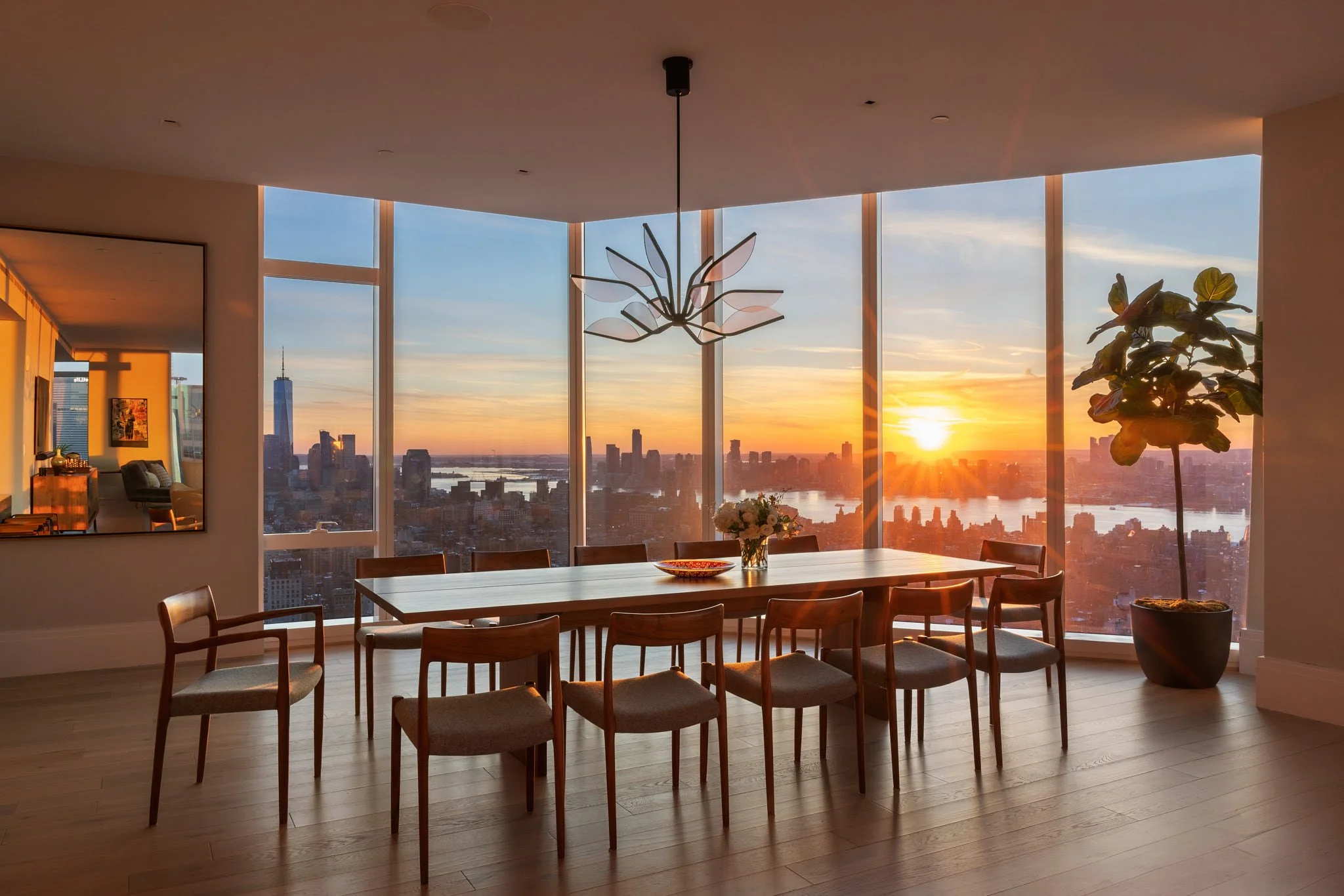
The transformation comes down to the sponsor's decision to treat this residence differently from every other unit in the tower. Rather than delivering it with the standard developer package, the sponsor commissioned Hill West Architects and Whitehall to fully design and build it out to a higher standard, specifically to make it stand apart in the building.
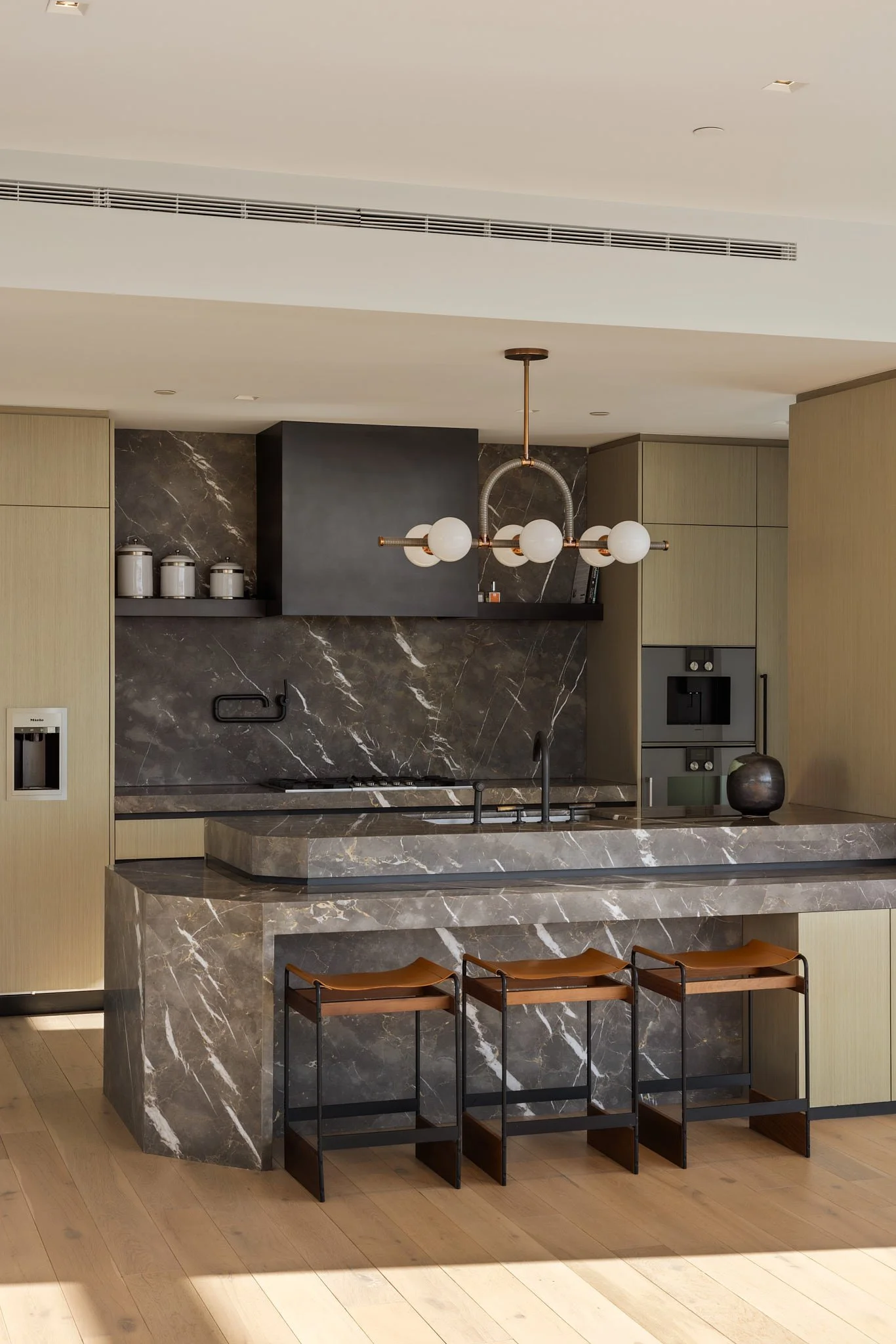
You feel that immediately in the finishes. Custom Molteni cabinetry, Portoro marble at the wet bar, Statuary marble in the primary bath, and much more were specified for this unit. Everyone who’s previewed the space has had the same reaction: it simply feels more considered, more refined, and more complete than anything else in the tower.
This is a residence the sponsor singled out for a bespoke treatment, where the design, materials, and execution go beyond what you’ll find anywhere else in the building.
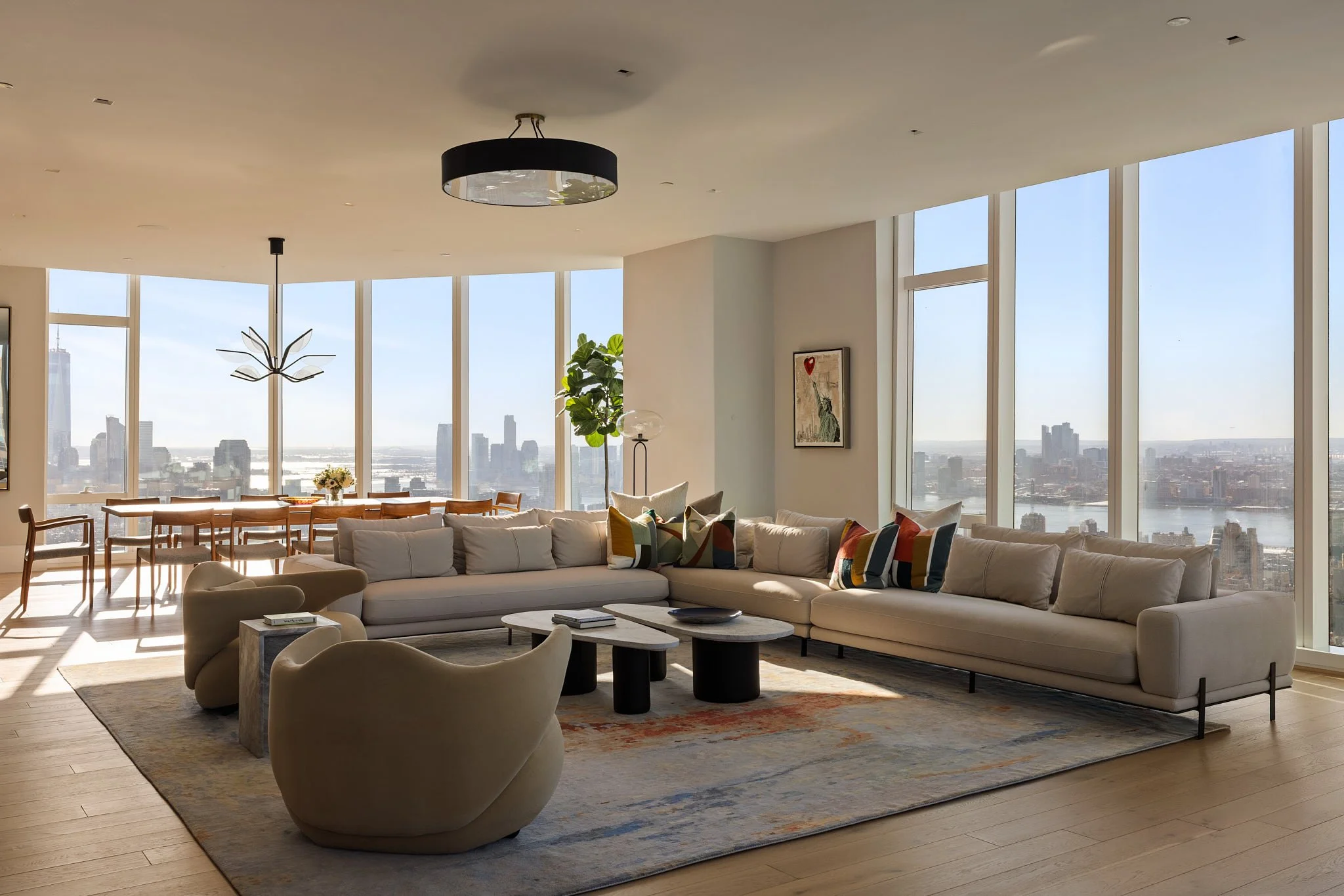
The layout follows that same philosophy. The great room is a true standout, nearly 1,200 square feet with rare triple exposure, pulling in north, west, and south light throughout the day.
How rare is a great room of this size with triple exposures in today’s market?
Genuinely rare, and the reason comes down to how new development in New York is engineered.
Modern luxury floor plates are designed to maximize unit count per floor. Developers slice each floor into as many sellable residences as possible, which means most units end up with one exposure, occasionally two if they sit on a corner. Even at the top of the market, a corner unit with dual exposures is considered a strong configuration.
Triple exposures require a residence to occupy a position that essentially spans three sides of the building. That alone eliminates the vast majority of new construction inventory. When you add the scale of a 1,200 square foot great room to that configuration, the pool narrows dramatically further. Most dual-exposure corner layouts in new developments deliver living spaces at a fraction of that size, because the floor plate simply doesn't allow for both the exposure count and the square footage in a single room.
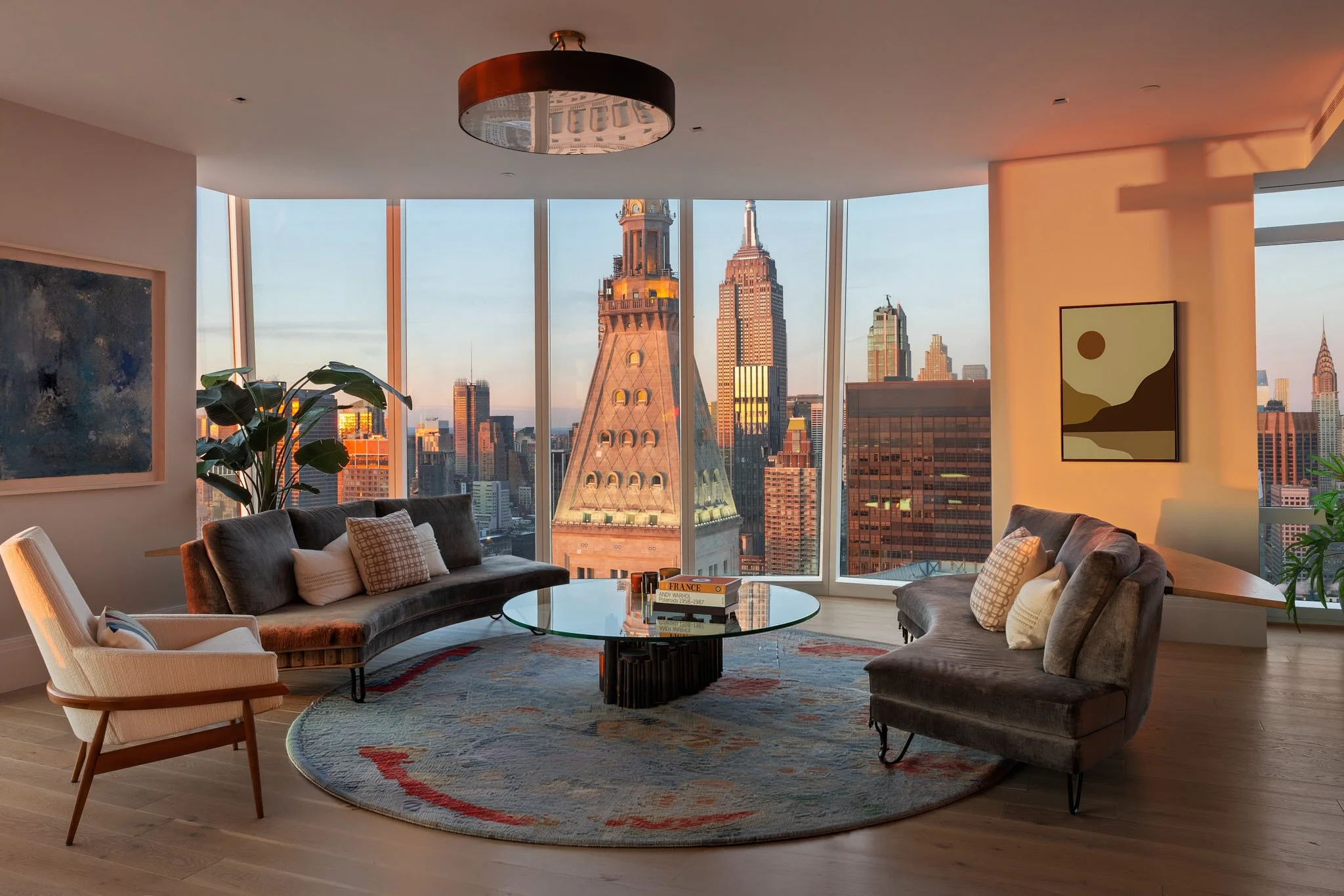
Layer in the specific view here, sweeping from Met Life and the Clocktower across to Chrysler, Empire State, and down to the World Trade Center, and the configuration moves from rare to essentially singular in the current market. It's not just a matter of finding another triple-exposure great room. It's finding one with this scale, this view, and at this elevation in a full-service condominium.
That combination is what puts this residence in a category of one.
What stands out most about the views from the MetLife Tower to the One World Trade Center?
What stands out is that the view isn't just long, it's a continuous sweep through the most recognizable architecture in New York City.
Most high-floor Manhattan residences capture a slice of the skyline. You might get the Empire State Building from one window, or a downtown view from another, but rarely do you get an unbroken visual line that connects multiple eras of the city's architectural history in a single frame. From this great room, the eye travels north to south across roughly a century of New York landmarks without interruption.
The Met Life Tower and the Clocktower anchor the view in the foreground. These are early 20th century landmarks, the kind of ornate masonry towers that defined the Madison Square skyline before the supertalls arrived. Because the residence sits directly above Madison Square Park, these buildings read at an intimate scale, almost like you're looking at them eye to eye rather than down at them.
The Chrysler's crown and the Empire State's spire are unobstructed, which is increasingly uncommon as new towers continue to rise around midtown. Here, the position above Madison Square Park gives the residence a protected outlook to the south and west, which is what allows the full sweep to read as a single panorama rather than a collection of partial views.
So the standout isn't any one landmark. It's the continuity, the elevation, and the fact that the view holds together as one composition from end to end.
What makes the primary suite feel like a true retreat? Were any specific decisions made to create a more retreat-like feel?
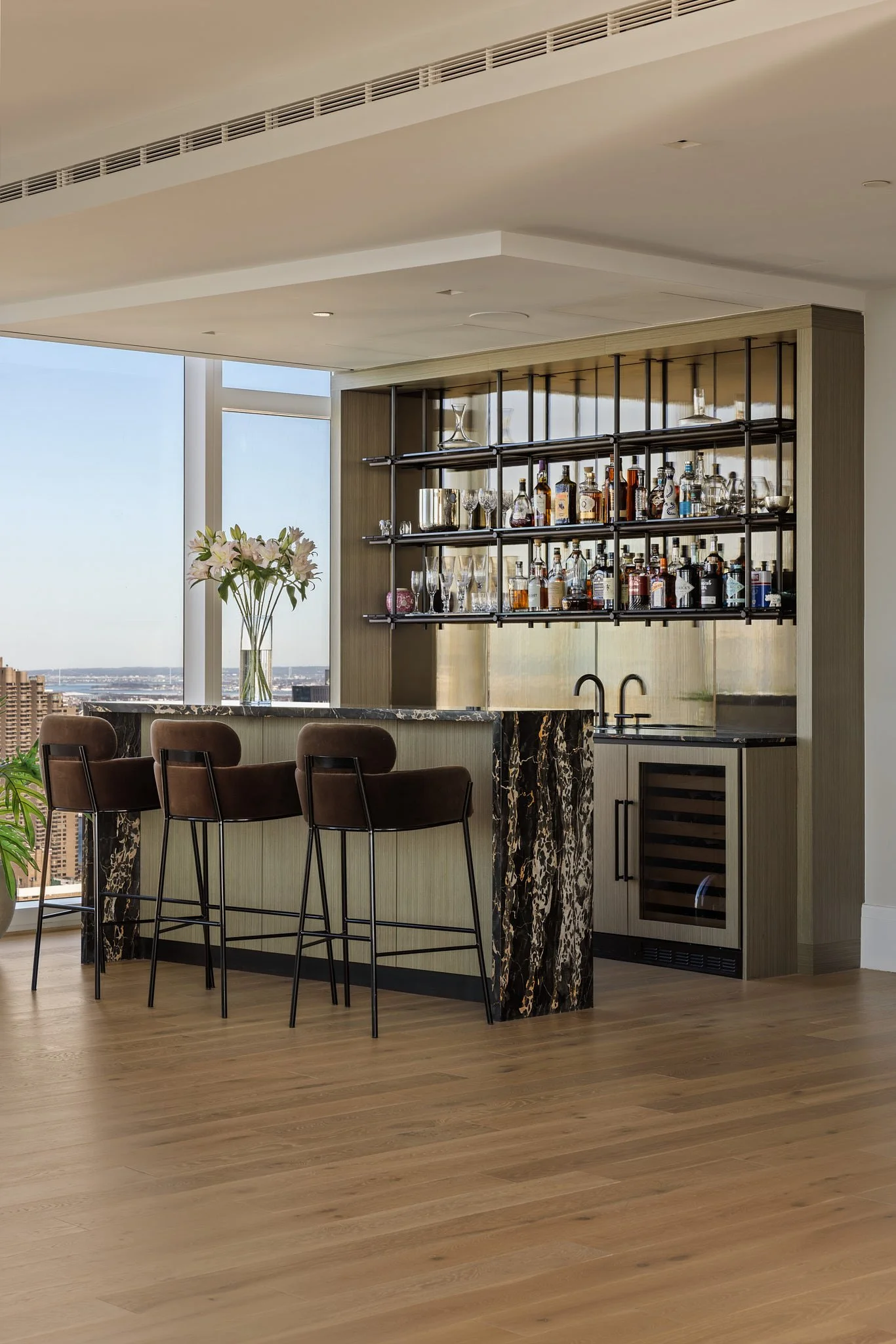
For entertaining, the entire 52nd floor reads as one continuous social space. You arrive at the private elevator landing, move through the gallery foyer, and the great room opens up with the triple exposures and the full skyline view. The 1,200 square foot scale means a cocktail party of fifty people doesn't feel crowded, and a dinner for twelve at the table doesn't feel lost in the room. The open kitchen with the marble island anchors one zone, the dining area another, and the seating around the views forms a third, all without walls breaking up the flow.
The two-kitchen setup is what makes hosting at that scale actually work day to day. The chef's kitchen tucked behind it absorbs the mess, the prep, the catering staging, the dishes piling up. Guests never see the working side of a dinner party. The wet bar in Portoro marble handles drinks service without anyone needing to cross into the kitchen zone, and the powder room off the gallery foyer keeps guests out of the bedroom wings entirely.
The secondary bedroom wing on the 52nd floor keeps family or guests separated from the entertaining spaces, with their own marble baths and a windowed laundry room nearby for the practical rhythm of the household. The primary suite upstairs on the 53rd floor is the move that makes the whole residence work as a home rather than just a showpiece. It has its own entrance, separating private life on the upper floor from entertaining below, each with its own circulation and its own quiet.
What is the first impression when buyers step off the private elevator?
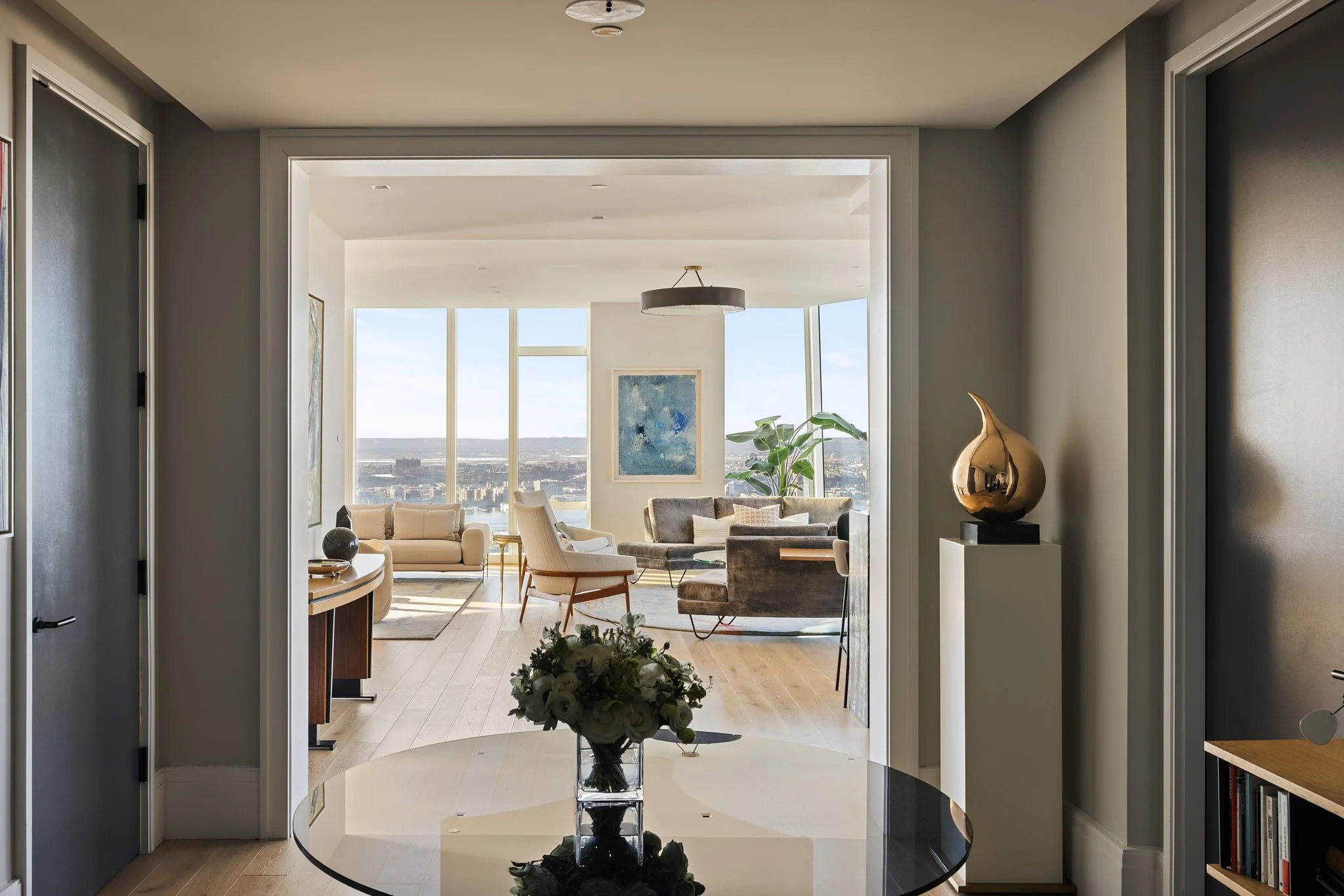
The first impression is anticipation. The private elevator opens directly onto a landing that belongs to this residence alone. A south-facing viewing window frames the lower Manhattan skyline right at the landing, so the experience of the home begins before you've even crossed the threshold. You're already in the view.
You move through a defined entry before the great room opens up, and when it does, the 10-foot floor-to-ceiling windows and the triple exposures hit all at once. The pacing matters. Most apartments give you the view immediately and lose the sense of occasion. Here, the elevator landing, the viewing window, and the foyer build toward the great room, so the first impression isn't a single moment but a sequence that ends with the full skyline opening up in front of you.
How does being near Madison Square Park shape the lifestyle here?
Madison Square Park functions as the building's front yard, anchoring daily life in a way most luxury addresses can't replicate. Morning runs, dog walks, the seasonal Mad. Sq. Art installations, and the holiday market all sit at the doorstep, with Eleven Madison Park and the original Shake Shack both on the park's edge, capturing the range of the neighborhood in two restaurants. The Flatiron District around it is dense with strong dining, designer boutiques, the Union Square Greenmarket, and subway access at 23rd Street that puts you on nearly every line within a few blocks.